Introduction
UK retailers have been hit hard in the past few weeks by cyber attacks, and it appears the criminal may be turning their attention to the US market next. Bearing a close resemblance to the “Scattered Spider” attacks that dominated headlines in 2023, many organizations are once again thinking about how social engineering and ransomware attacks can lead to disastrous consequences.
Social engineering is a particularly challenging threat vector as it exploits the historically weakest link in most cybersecurity programs – employees themselves. Automated threat intelligence (ATI) offers novel approaches to mitigating this risk and to creating an early detection and warning system that criminals may be targeting an organization.
The speed, scale, and sophistication of cyber threats mean that traditional, manual methods of detecting and responding are proving inadequate. This blog explores why cybersecurity leaders must embrace ATI to stay ahead of emerging threats, especially those rooted in deception and human manipulation.
Social Engineering is the New Normal
Threat actors are increasingly well-funded, organized groups deploying advanced tactics to disrupt businesses, steal data, and extort millions. Social engineering, phishing, and identity-based attacks are surging, accounting for a significant number of breaches.
According to industry data, over 90% of successful cyber attacks begin with some form of social engineering. In this context, waiting days—or even hours—for analysts to review logs and correlate threat data is simply too slow.
Attacks like the “Scattered Spider” campaigns show how attackers can manipulate employees and exploit internal access to deploy ransomware at scale. Traditional tools cannot keep pace with this level of speed and coordination. Cybersecurity leaders need a faster, smarter, and more scalable solution.
What Is Automated Threat Intelligence?
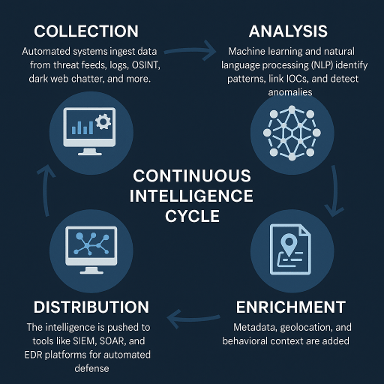
ATI is the use of AI-driven systems to automatically collect, analyze, and act on threat data from various sources in real time. Unlike traditional threat intelligence, often reliant on static lists and manual analysis, ATI dynamically processes thousands of signals per second from dark web forums, phishing kits, domain registrations, malware repositories, and more.
Here’s how this continuous intelligence cycle gives security teams an edge against fast-moving and deceptive adversaries:
How ATI Helps Defend Against Social Engineering
Social engineering attacks rely on human trust, manipulation, and deception. They are difficult to detect with conventional tools because they often involve no malware—just cleverly crafted emails, phone calls, or fake websites. ATI provides multiple layers of defense against these tactics:
| Capability | Description |
| Early Detection of Phishing and Impersonation Campaigns | Monitors phishing kits, domain registrations, and impersonation tactics in real time. Flags suspicious domains and uses NLP to scan emails for urgency and deception cues. |
| Threat Actor Behavior Correlation | Connects phishing emails, infrastructure, and impersonation activity to known TTPs, revealing hidden links across attacks that humans may overlook. |
| Contextual Alerting | Enriches alerts with domain reputation, historical incidents, and threat actor profiles to help analysts triage and respond quickly. |
| Social Media and Brand Monitoring | Scans platforms and forums for fake executive accounts, fraudulent support pages, and brand abuse—often used in pretexting and disinformation attacks. |
| Automated Response | Automatically quarantines phishing emails, alerts users, and updates security tools to block future threats. |
| User Education and Feedback | Uses real-time threat data to deliver contextual training to employees, turning each attack attempt into a learning opportunity. |
Beyond Social Engineering
Cybersecurity is not just about defending the perimeter—it’s about staying ahead of adversaries who are increasingly automated. While social engineering dominates the headlines, the reality is that today’s attack surface is too vast, and threat actors too agile, for manual defenses to keep up. That’s ATI becomes essential.
ATI doesn’t just help you respond—it helps you anticipate. For cybersecurity leaders tasked with safeguarding critical infrastructure, protecting sensitive data, and enabling business continuity, embracing ATI isn’t just a competitive advantage—it’s a strategic imperative.
1. Keeping Pace with Attack Velocity
Modern cyberattacks are fast, multi-vector, and often automated. Manual detection and response processes simply can’t keep up. ATI enables real-time threat detection and response, narrowing the window of exposure before damage is done.
2. Tackling Alert Overload
Security teams are overwhelmed with false positives and redundant alerts. ATI can prioritize threats based on risk context, dramatically reducing noise and ensuring that analysts focus on what matters most.
3. Bridging the Talent Shortage
There’s a global shortage of skilled cybersecurity professionals. ATI amplifies the impact of existing teams by automating routine tasks and accelerating triage, allowing organizations to do more with fewer resources.
4. Enhancing Threat Intelligence Quality
ATI doesn’t just aggregate feeds—it enriches them with context (e.g., TTPs, geolocation, behavioral patterns), creating high-fidelity intelligence that’s usable in defense strategies.
5. Reducing Dwell Time
The time between breach and detection (dwell time) remains a critical vulnerability. ATI shortens this by continuously monitoring and correlating signals that would otherwise go unnoticed by human analysts.
6. Enabling Adaptive Security Posture
Attackers evolve—so must defenses. ATI continuously learns from new data, enabling adaptive and self-improving systems that evolve faster than traditional signature-based defenses.
7. Supporting Compliance and Reporting
ATI provides auditable, consistent, and policy-aligned data that simplifies regulatory compliance, incident reporting, and board-level communication.
The Future of Threat Intelligence: AI-Driven Security
The next evolution of ATI is not just about automation—it’s about autonomy.
Modern systems are moving toward predictive and adaptive security, using behavioral analytics and machine learning to anticipate threats before they materialize. Future ATI will detect attacker intent based on reconnaissance behavior, respond autonomously to neutralize threats, and integrate with broader digital risk protection strategies.
However, this power must be balanced with transparency and ethics. AI-driven decisions must be both explainable and accountable, particularly in regulated industries such as finance, healthcare, and critical infrastructure. For example, when a bank’s ATI system flags a customer transaction as potentially malicious, compliance officers must understand why the decision was made to ensure it aligns with anti-fraud regulations and doesn’t result in unjustified account freezes. In healthcare, ATI may help detect unauthorized access to patient records, but if the reasoning behind the alert isn’t traceable, it can complicate HIPAA compliance and erode trust. And in national security contexts, automated attribution or escalation must be verifiable to prevent false positives from triggering geopolitical consequences. As organizations increasingly rely on ATI to power their cyber defenses, they must also ensure that these systems are transparent, auditable, and grounded in responsible AI principles. Only then can the benefits of speed and scale be fully realized, without compromising trust.
From early detection of phishing and impersonation attempts to automated enrichment, response, and user education, ATI transforms fragmented data into proactive defense. It uncovers hidden patterns, links threat activity to known adversaries, and delivers actionable insights in real time, enabling faster, smarter decisions. Most importantly, it allows security teams to stay one step ahead: anticipating where threats are likely to emerge, how they’ll unfold, and what actions must be taken before damage is done. For organizations serious about building resilient, future-ready security programs, ATI is not just an enhancement—it’s an imperative.
About Analyst1
Threat intelligence teams often struggle to bridge the gap from insight to action. Analyst1 is the Orchestrated Threat Intelligence Platform designed to resolve this issue. It automatically organizes threat data, links it to your assets and vulnerabilities, and customizes views for different roles. Analyst1’s orchestration layer streamlines workflows and automates reliable actions by integrating with SIEM, ticketing, and vulnerability management systems. From Fortune 500 financial institutions to national security agencies, enterprises trust Analyst1 to unify their defenses, significantly reducing their response time from days to minutes.